
Understanding lipedema stages and types
Doctors describe lipedema in two ways. The stage describes how much the skin and fat tissue have changed. The type describes where on the body the lipedema fat collects.
Every person with lipedema has both, so a diagnosis might read “Stage 2, Type III.” Knowing your lipedema stage and type can help you talk with your care team, understand your treatment options, and track changes over time.
The 4 stages of lipedema
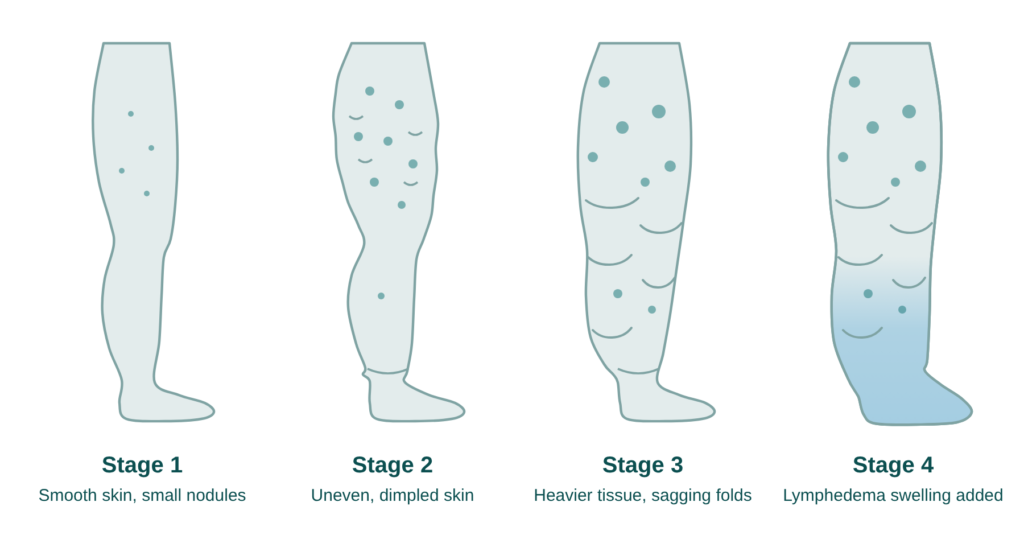
Lipedema stages describe changes in the skin and the tissue beneath it. They range from Stage 1, the earliest, to Stage 4, when lymphedema has developed alongside lipedema.
Stage 1 lipedema
The skin looks smooth, but the fat layer underneath is thicker than usual. Small nodules, often described as feeling like rice grains or pebbles, can be felt under the skin. Easy bruising and tenderness may already be present.
Stage 2 lipedema
The skin surface becomes uneven, with dimpling or a “mattress-like” texture. The nodules grow larger and more numerous, and the overall amount of lipedema tissue increases.
Stage 3 lipedema
The tissue becomes heavier, firmer and more fibrous, with larger nodules. Folds and lobes of tissue may form and sag, especially around the thighs and inner knees, changing the shape of the legs.
Stage 4 lipedema (lipo-lymphedema)
Lipedema is combined with lymphedema, a buildup of lymph fluid that causes swelling. Some doctors call this “Stage 4”; others call it lipo-lymphedema and keep the stages at 1 to 3. Swelling may reach the feet or hands, which lipedema alone usually spares.
Researchers have also proposed in-between stages (1.5 and 2.5), because lipedema often changes gradually rather than in clear steps.
The 5 types of lipedema
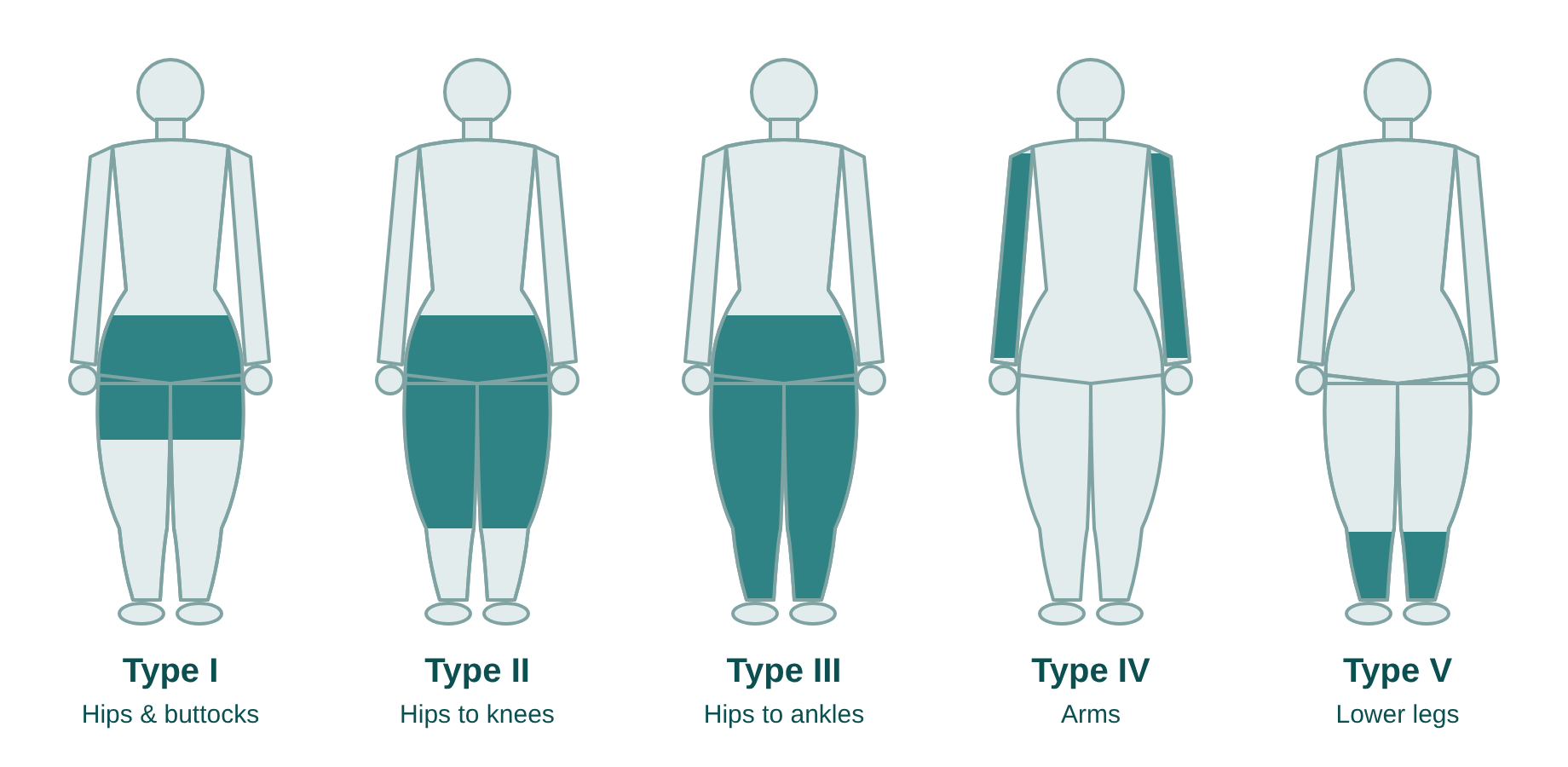
Lipedema types describe where the fat collects. Lipedema almost always affects both sides of the body evenly, and it usually stops at the ankles or wrists, leaving the feet and hands slim. That can create a visible “cuff” or ring of tissue just above the ankle or wrist.
| Type | Areas affected |
|---|---|
| Type I | Pelvis, buttocks and hips, sometimes called “saddlebags” |
| Type II | From the buttocks down to the knees, often with folds of tissue at the inner knee |
| Type III | From the buttocks all the way down to the ankles |
| Type IV | The arms, usually the upper arms, stopping at the wrists |
| Type V | Mainly the lower legs and calves (the least common type) |
Many people have more than one type of lipedema. Arm involvement (Type IV) most often appears together with Type II or Type III.
What your lipedema stage and type can and can’t tell you
- Stage is not the same as how you feel. Lipedema stages describe how the tissue looks and feels to the touch, not how much pain, heaviness or fatigue you have. Someone in Stage 1 can have significant pain.
- Lipedema does not always progress. Many people stay at the same stage for years, and early care may help slow changes.
- Your type can include more than one area. Knowing every affected area helps your care team plan therapy and, if relevant, surgery.
- Only a clinician can diagnose you. Lipedema is often mistaken for obesity or lymphedema. A doctor familiar with lipedema can confirm your stage and type during an exam.
Frequently asked questions about lipedema stages and types
Can lipedema be reversed?
There is currently no cure for lipedema. Conservative care, such as compression, manual lymphatic drainage and regular movement, can ease symptoms and may help slow changes. For people who are good candidates, lymph-sparing liposuction can remove lipedema fat.
Does lipedema always get worse?
Not always. Some people stay at the same stage for many years. Symptoms often change around times of hormonal shift, such as puberty, pregnancy and menopause.
Is Stage 4 lipedema the same as lymphedema?
No. Stage 4 means lymphedema has developed in addition to lipedema, which is why it is also called lipo-lymphedema. Lipedema on its own is a different condition from lymphedema.
Is lipedema the same as obesity?
No. Lipedema fat collects in a symmetrical pattern, is often painful or tender, bruises easily, and does not respond to diet and exercise the way ordinary fat does. Lipedema and obesity can occur together, which is one reason lipedema is often missed.
How is lipedema diagnosed?
There is no single blood test or scan for lipedema. A clinician diagnoses it through a physical exam and your medical history, looking at the pattern of fat, tenderness, bruising and whether the feet and hands are spared. Imaging may be used to rule out other conditions.
Next steps
If this sounds familiar, our Lipedema Symptom Checklist can help you organize your symptoms before an appointment. When you’re ready, Find a Provider explains which lipedema specialists can help at each stage, with a searchable directory for each.
This page is general information, not medical advice. Please talk with your own doctor about your symptoms, diagnosis and treatment.
Sources: Standard of Care for Lipedema in the United States (2021); New Characterization of Lipedema Stages, Life journal (2025); Lipoedema UK: Stages and Types.